Extend labeling control beyond your four walls so every supplier shipment arrives correctly identified, compliant, and ready to receive
Most manufacturers have spent years getting their own labeling right. Templates are approved and version-controlled, and the print history is there when an auditor asks for it.
Then a pallet arrives from a supplier. The barcode will not scan against the expected format, or the carton carries the supplier's part number instead of yours. Sometimes there is no usable identification on it at all. None of your internal controls help, because you didn't create the label. The supplier did.
Supplier label compliance means extending the control you already have over your own labeling to the labels your suppliers and contract manufacturers print.
For most manufacturers, it is the last part of product identification still out of reach, and it decides whether inbound goods arrive ready to receive or waiting to be fixed.
Supplier label compliance is the practice of controlling the label content and data on goods a company receives from its suppliers, so inbound items can be identified and processed without rework. It extends a company's own labeling standards across the supplier boundary.
Most organizations concentrate their labeling investment on what leaves the building, because outbound labels are what regulators inspect and customers see. Loftware CEO Jim Bureau named the consequence when Loftware Connect was launched: for decades, product identification has been managed within the four walls of the enterprise, while goods move across borders through suppliers, co-packers, and distribution centers.
What arrives at your dock was labeled by someone else, to their standard.
The problem shows up first as tied-up cash. Goods coming in from your supplier network have to be identified quickly, so receiving knows where they belong in the warehouse and where they fit in production. When a pallet arrives that can't be identified against the expected format, that whole process stops. Warehouse staff either open a relabeling job, which adds a step and a cost to every affected pallet, or they set the goods aside because nobody can confirm what they hold. Either way, the stock sits, and stock that sits is working capital you have already paid for and cannot use.
Sometimes the math tips further. Goods that can't be processed fast enough sometimes just get incinerated, because sorting out what to do with them holds up everything behind them.
Throughout, you carry the accountability for a label you did not print and could not see.
When a filling line goes down, production stops… and the whole plant knows about it. Someone escalates it, someone logs it, and the cost lands in a report a director reads that week.
A mislabeled inbound pallet does none of that. It delays one shipment. It creates one relabeling job. It could hold a few thousand dollars of stock for a few days. Each event is small enough that the person handling it just deals with it and moves on.
The inventory cost never gets counted. Receiving absorbs the rework as part of ordinary workload. Finance sees inventory turns come in slightly soft with no cause attached to them. No single event is ever big enough to earn a line on anyone's report.
That is what makes supplier labeling different from the problems that companies do track. The cost lives in how these incidents add up, not in any single occurrence. A company receiving from four hundred suppliers across a dozen sites pays it continuously, and because no one event is worth escalating, no one ever adds them up.
The real cost of a mislabeled shipment is spread across five places, and most of it never gets traced back to the label that caused it.
Production disruption |
This is the one that hurts most. A component that can't be identified can't be released to the line, so the build waits on it. A labeling failure at receiving stops being a warehouse problem the moment it holds up production, and a stalled line is measured in far bigger numbers than a relabeling job. |
Rework and scrap |
Someone has to identify the goods, generate a correct label, apply it, and re-book the item. At a few minutes per carton across a large inbound volume, those minutes turn into hours spent by staff you hired to move product, not to correct paperwork. When the goods can't be recovered at all, rework becomes scrap, and you write off inventory you already paid for. |
Quarantined stock |
Goods that can't be identified can't be allocated to a production order, so they sit. Stock that sits takes up space, drops out of your inventory count, and ties up working capital you have already spent. The longer it waits, the more it costs, and none of that cost shows up attached to the labeling error that caused it. |
Expedited freight |
When held stock stalls a firm production date, the fix is usually a rushed replacement. Expedited freight against a deadline routinely costs several times the value of the labeling error that triggered it, and it is spent to recover time the error took away rather than to add anything. |
Compliance exposure |
In a regulated category, a component you cannot trace to its source is an audit finding waiting to happen. That finding is not measured in warehouse hours, and it is the one cost on this list that can stop a shipment leaving the building or trigger a recall after it already has. |
None of these typically show up as a single number anywhere. A company receiving from hundreds of suppliers across multiple sites runs all five at once, continuously, at a rate no one is currently measuring.
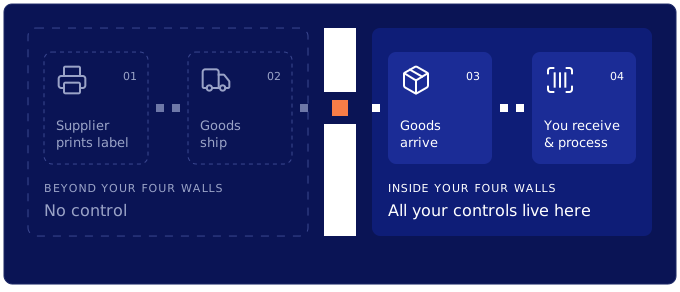
Supplier prints label → Goods ship → Goods arrive → You receive & process
Standardization keeps work consistent inside your four walls. But the label on an inbound item is created beyond them, at the supplier, before your controls ever apply. Supply chain collaboration is what extends that control across the boundary.
Most companies have already tried to fix supplier labeling. The tools they reach for are the ones already on hand: a specification document, a supplier portal, an EDI feed, a shared drive. Each one moves information to the supplier. None of them controls what the supplier prints.
A specification describes a label. It does not produce one. You send a PDF or a drawing, and every supplier builds their own version of it in their own system, interpreting it their own way. Nothing confirms they built it correctly, and nothing tells you when a supplier is still printing last quarter's version.
A portal and a shared drive have the same limit. They give suppliers a place to fetch the current document, but the supplier still recreates the label at their end, and standards shared this way drift out of date the moment they change. When you revise a spec, you are back to chasing every supplier one at a time, with no way to see who has adopted the new version until their goods show up at your dock.
EDI handles data well, but EDI carries transaction data, not label templates. Even when suppliers exchange data cleanly through EDI or GS1 standards like GS1-128, the label itself, the physical barcode and format on the goods, is where the format problem survives and stops a pallet at receiving.
The pattern underneath all four is the same. Compliance failures happen at the handoff, where information is incomplete, outdated, or misinterpreted. You can prove what you asked your suppliers to print. You cannot prove what they actually printed.
Supplier compliance depends on something being true first: control over your own labeling. If each of your plants keeps its own templates, a packaging change gets re-entered by hand at every site, and one missed update ships the wrong format. Pushing an inconsistent standard out to suppliers just spreads the inconsistency further
Getting your own labeling governed and consistent is the foundation supplier compliance builds on. Loftware Cloud handles that internal groundwork; supplier compliance is the next step outward, not a replacement for it.
Loftware Connect changes who controls the label. Instead of receiving whatever a supplier's system produces and fixing it at your dock, you define what goes on the labels of incoming goods, and suppliers print to that definition directly.
Connect is a collaborative network. Your suppliers and contract manufacturers work in secure labeling workspaces, pulling approved templates and data live from you rather than from a copy saved months ago. They print the label onto the item before it ships, so the goods arrive already identified correctly. The problem gets resolved before it exists, because the information on the item is right at the point it's created instead of corrected at receiving.
Four mechanisms do the work:
Partners always print from your current approved template. Version drift at the supplier stops being possible, rather than being caught after the fact.
When a regulation or customer requirement changes, you push the update in a single action and see which suppliers have adopted it. The alternative is emailing every supplier and finding out who missed the message when their goods arrive.
Data coming back from suppliers arrives against a defined template and is validated at intake, so nobody re-keys attachments into your systems.
A supplier can't proceed with a superseded label, and one record covers everything your network printed, which is what an auditor asks to see.
Two things make adoption realistic. Suppliers need only a login and an internet-connected device to start printing compliant labels, and they never get access to your internal labeling systems. Connect works the same way toward your customers, so the goods you ship out meet their standards as reliably as what you receive meets yours.
When exploring a supplier labeling solution, these are the questions worth asking. They separate a tool that moves documents to your suppliers from one that actually controls what gets printed.
If the answer to any of these is no, that gap is where cost and risk are leaking today.
The hardest part of supplier compliance isn't the software. It's getting suppliers to change how they work, and that depends almost entirely on how much you're asking of them.
A specification-based approach asks a lot. The supplier has to build your template in their own system, maintain it, and rebuild it every time you revise the standard. That cost lands on the supplier, so compliance ends up riding on how much commercial weight you carry with them. Your largest suppliers may go along. Smaller ones, or ones for whom your business is a rounding error, often won't.
A solution like Loftware Connect changes the ask. A supplier logs in and prints from a template you maintain. There's nothing to build, nothing to install, and no rework when the standard changes. Compliance can actually save the supplier a few minutes, which makes adoption more realistic across a network rather than an extra step for each supplier.
How you roll it out still depends on your situation. A regulated category can often mandate the standard. Other companies phase it in as contracts come up for renewal, or they may start with the handful of suppliers responsible for most of their inbound volume. On the largest rollouts, systems integrators may handle the change management. Which path fits yours is exactly the kind of question a Loftware solutions consultant can work through with you.
The business case for supplier compliance is hard to make for one reason: even though the cost is real, nobody has counted it. So building the case starts with measuring. You gather the numbers the business isn't tracking, and the numbers make the argument for you.
Start by measuring five things:
Take any one of these to a budget conversation and you've turned an invisible cost into a line someone can act on. That the business couldn't produce these numbers before is itself part of the case.

Inbound labeling errors cost more than relabeling labor. See where the cost hides in inventory, production, and freight, and how to stop it upstream.

Label specifications leave every supplier rebuilding your template. See how Loftware Connect shares approved templates and speeds supplier onboarding.

What is artwork management? See how brands move packaging artwork from brief to approved print-ready file, and how approved content reaches suppliers.

Auditors ask which label version a supplier printed, not what you sent. See how Loftware Connect records published content and partner activity.
What is supplier label compliance?
Supplier label compliance is the practice of controlling the label content and data on goods a company receives from its suppliers, so inbound items can be identified and processed without rework. It extends internal labeling standards to the partners who print on a company's behalf. |
Who is responsible when a supplier prints the wrong label?
The receiving company carries the operational and regulatory consequences, whoever printed the label. Auditors and customers hold the brand owner accountable for product identification, which is why controlling supplier labels matters more than assigning blame for them. |
How do you get suppliers to use the correct label template?
Sending a specification asks each supplier to rebuild your template themselves, and results vary. Giving suppliers direct access to your current approved template removes the rebuild step, so they print the right version because it's the only version available to them. |
What happens when goods arrive with the wrong barcode?
Receiving can't identify the goods against the expected format, so they're either relabeled at your cost or held until someone works out what they are. Both delay availability, and held stock ties up cash and space until it's resolved. |
How long does it take to push a label change to all suppliers?
With emailed specifications, adoption takes weeks and can't be confirmed until goods arrive. On a connected network, a change publishes in one action and adoption is visible immediately, so you know who's current before the next delivery. |
What's the difference between supplier labeling and internal label management?
Internal label management governs what your own sites print. Supplier labeling governs what your partners print. Most companies need internal control first, because a standard can't be extended outward reliably until it's consistent inside the business. |
How do you prove supplier label compliance in an audit?
You need a record of which template version each supplier printed, and when. Without a shared system, that has to be reconstructed from supplier correspondence after the fact. With one, a single audit trail covers every label printed across the network. |
What does it take to onboard a new supplier to a labeling standard?
With a low-touch system, a supplier needs a login and an internet-connected device. No software is installed on their end and no access is granted to your internal systems, so onboarding takes minutes rather than becoming an integration project. |
Supplier label compliance is the last part of product identification most companies haven't been able to reach, and it's where the hidden costs of inbound labeling add up. Loftware Connect closes that gap, extending the control you already have over your own labeling to every supplier who prints on your behalf.
The right path to supplier label compliance depends on your situation: which suppliers matter most, what your industry requires, and how your labeling is set up today. A short conversation with a Loftware solutions consultant will tell you what supplier compliance would look like in your business, and what it would take to get there.